
Can AI-Written Content Rank Well on Google? (This May Surprise You)
Increasingly, brands are leveraging AI-written or AI-assisted content for blogs and web copy. And increasingly, the internet has become saturated with AI content, to the point that readers struggle to distinguish between the two..
The May 2026 Google Core update shone a spotlight on a core issue that’s been on many SEOs’ minds since the advent of AI in 2022: will AI-generated content rank well on Google? Or will it eventually be penalized?
To no SEO’s surprise, many sites were dinged this past summer. Some stopped ranking altogether and are still scrambling to regain their rankings.
This might seem like a distinct warning to brands to stop using AI-written content. However, when you examine the numbers, an interesting trend arises: sites with significant human oversight, that maintained a strong brand identity and stayed aligned with Google’s E-E-A-T standards, did not suffer from the last core update.
If anything, these brands saw their reach and rank soar, whether they used AI-assisted content or not.
Quick Summary: AI-assisted content can rank well on Google, but it seems to require significant human oversight to ensure accuracy, alignment with brand voice, and proper SEO/GEO structure.
- AI forgets context and degrades over time: Long chat threads cause memory drift and lower output quality.
- AI hallucinates data: It struggles with independent research, but acts as an incredible accelerator when guided by human sources.
- AI understands SEO rules, but not accountability: It will optimize for structure, but won’t check if its own statements are true.
- Complex prompts cause bottlenecks: Overloading an AI with contradictory instructions leads to robotic, generic copy.
Best Practice: Outline your thesis and supporting points first and conduct original research before prompting. Feed the AI explicit constraints, edit out stylistic “tells,” and never assume line-level quality will stay consistent without active editing.
How AI Scans the Internet for Answers

So, what’s the truth? Is Google truly impartial to the method of writing, as long as readers still find the content useful, informative, or entertaining?
To answer that, we first must understand how AI scans the internet for answers.
If I had to convey one core concept that would help a new writer understand SEO (Search Engine Optimization) I would say this:
If your copy matches the user’s search intent and gives them a direct answer right away, your copy will rank well.
When your writing also layers in highly-informative context and data that helps the reader, is thought-provoking, or delights them beyond their expectations, then you’ll own that ranking.
With GEO (Generative Engine Optimization), the rules shift slightly: An AI engine can love your direct answer, but to quote you as the source, your copy needs distinct, factual hooks: original research, a proprietary framework name, or explicit structured data.
SEO asks, “Does this satisfy the query?”
GEO asks, “Is this the most authoritative factual source I can synthesize and cite?”
How AI Teaches SEO + GEO
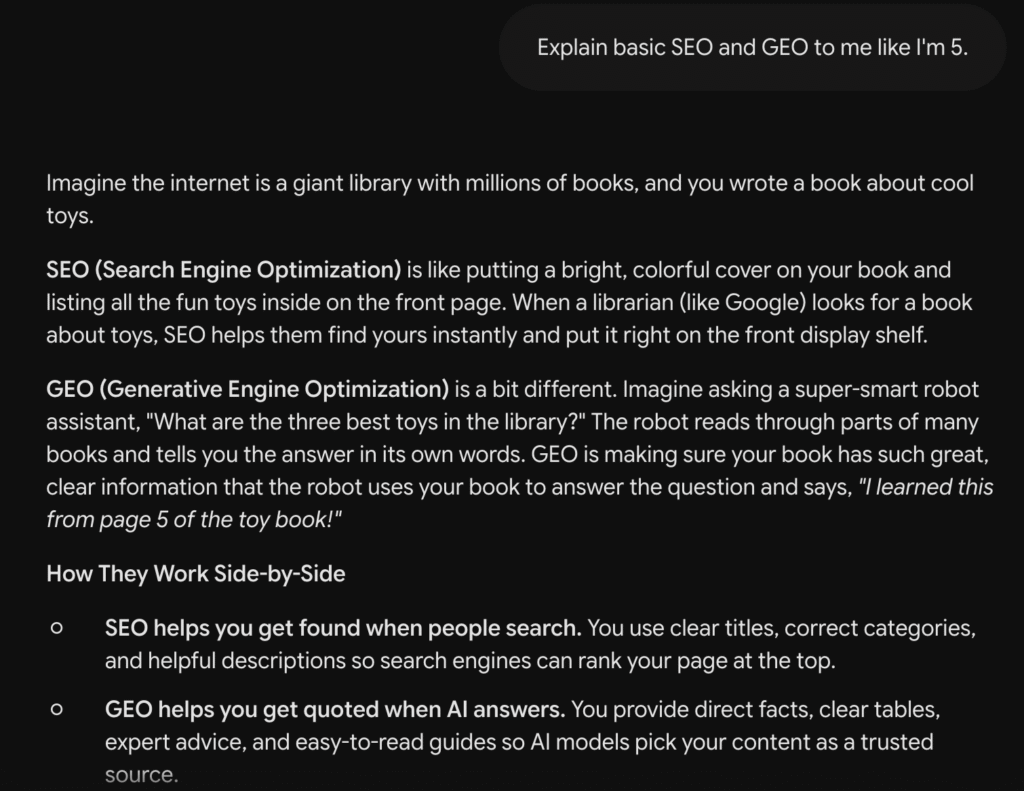
One of AI’s huge advantages is its ability to explain complex concepts in direct, straightforward terms. This is because AI can easily scan the internet and digital publications for information, and quickly parses it down into easy-to-digest summaries.
SEO and GEO are no exception to this rule. If you ask AI to explain the foundational principles behind ranking a website, it will. When you ask it to explain what a specific website needs in order to rank better, it easily pinpoints gaps in keyword strategy, intent targeting, and more—so long as you provide it with a complete picture and accurate information. (Yes, I, a human writer, just used an em dash. *gasps in 2026).
The only caveat I’d add here is that because AI can hallucinate, I wouldn’t lean on it as the only resource for learning SEO and GEO best practices. While it can easily and succinctly explain the core concepts of writing for the web, AI doesn’t always provide accurate information, and it sometimes gets things wrong.
Best Practice: If using AI to research or learn faster, ask for sources from Google whenever possible. Question it, make it prove its argument, and cross-check AI advice with advice from industry experts like SEMrush, StoryRank, or Neil Patel.
What AI is Good at When It Comes to SEO Writing
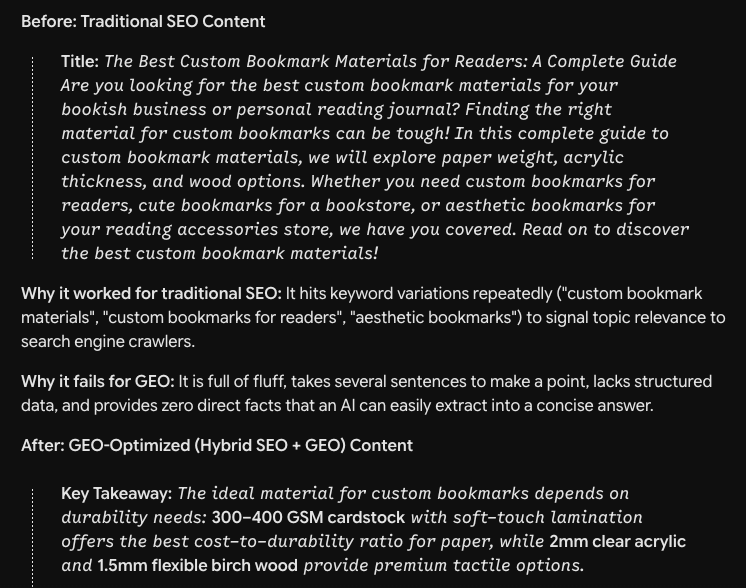
When properly directed, AI is an unmatched engine for volume, structural efficiency, and technical precision. It shines at processing large inputs and formatting them for search engines faster than any human writer can manage manually.
- Rapid Intent Alignment: AI excels at parsing search intent from top-ranking SERP competitors and structuring outlines that hit every expected subtopic.
- Structural Scaffolding: It effortlessly generates schema markup, formats clean tables, crafts bulleted summaries, and drafts direct-answer snippets optimized for featured search placement.
- Keyword Integration: It can naturally weave primary, secondary, and semantic keywords throughout a piece without the awkward phrasing often produced by novice writers.
- High Volume Drafting: It eliminates the friction of the blank page, drafting functional foundational copy that humans can immediately refine and elevate. (Though in my experience, this process is faster when humans outline the copy first).
Key Takeaway: If this formatting feels reminiscent of an AI response, that’s intentional. Structuring copy for quick human scanning double-dips as Generative Engine Optimization; AI models prioritize and quote content that is easy to parse.
What AI Often Misses (Your Site Will Tank If You Don’t Catch This!)

Left on autopilot, AI naturally drifts toward generic, high-volume mediocrity. It optimizes for predictability—which is the exact opposite of what builds brand equity or claims top search rankings.
- Original Insights & Proprietary Data: AI cannot conduct original interviews, run experiments, or offer real-world experience. It can only remix existing web consensus, leaving your content devoid of genuine E-E-A-T.
- Fact Drift & Confident Hallucinations: AI frequently invents statistics, cites non-existent studies, or misattributes quotes. Errors like this destroy brand trust and invite search quality penalties.
- Stylistic “AI Tells”: Overuse of empty transition phrases (“In today’s fast-paced digital landscape,” “Delve,” “Testament to”), repetitive sentence lengths, and generic fluff that inflates word count without adding information.
- Context Degradation: Over the course of a long project or multi-turn chat session, AI forgets earlier constraints, leading to tone shifts, repeated arguments, incorrect details, and deteriorating quality.
How AI-Written Content (With Extensive Human Oversight) Ranked Over a 6-Month Period
When brands combined structural AI drafting with rigorous human oversight, the performance metrics told a very clear story. Over a six-month tracking window following the Core Update, hybrid content consistently outperformed both pure human drafts and raw AI output.
Example: One recent client case study perfectly highlights the power of this hybrid approach. By combining structural AI drafting with rigorous human oversight, preserving the brand’s distinct voice, ensuring accurate positioning, and sharpening customer angles, we scaled content production without sacrificing editorial quality.
The results speak for themselves: over a twelve-month period (July 2025 to July 2026), the brand saw a 3,000+ increase in Year-over-Year impressions across core Feature pages, proving that search engines reward high-value, human-guided content.
The takeaway from the data was undeniable: Google didn’t penalize the tool used to generate the words; it penalized the absence of value. Sites that used AI to build the frame and human expertise to fill the room saw steady organic growth.
AI-Generated Content That Was Penalized in the May 2026 Google Core Update

The May 2026 update wasn’t an anti-AI update; it was an anti-spam update. The sites that suffered catastrophic traffic losses shared distinct operational patterns:
- Mass-Produced Programmatic Blogs: Sites pumping out hundreds of unedited AI articles daily to target long-tail keywords without adding unique value or original research.
- Circular Search Loops: Pages that answered a search query by simply rephrasing the question across ten paragraphs without delivering a clear, factual answer.
- Unverified Medical, Financial, or Legal Claims: YMYL (Your Money Your Life) websites that relied on unvetted AI copy containing subtle factual inaccuracies or missing real expert attribution.
- Synthetic Authority Sites: Domains attempting to fake E-E-A-T by generating fake author bios, hallucinated expert quotes, and superficial reviews of products the writer had never used.
Google’s algorithms have gotten exceptionally sharp at identifying content created solely to manipulate search results. If your copy reads like it was generated in 30 seconds for a crawler rather than crafted for a human reader, the search engine will treat it accordingly.
AI is a powerful amplifier, but it amplifies whatever you feed it: give it deep insight and structure, and it scales your authority; give it lazy prompts, and it scales your irrelevance.
SHOULD You Use AI Writing Heading Into 2027?
The short answer? Yes, but only if you redefine what “using AI” actually means for your content strategy.
Heading into 2027, the line between traditional search engines and conversational AI answers will continue to blur.
Treating AI as a hands-off, push-button content factory is no longer just a lazy strategy; it’s a direct threat to your domain authority. Google’s algorithms and generative engines are simply too sophisticated to be fooled by polished, surface-level fluff.
However, completely ignoring AI isn’t the answer either.
Competitors who master the hybrid model will produce higher volumes of structurally sound, deeply researched, GEO-optimized copy in a fraction of the time it takes a purely manual team.
If you want to leverage AI safely and effectively heading into 2027, your playbook should look like this:
- Use AI as an Architect, Not the Lead Writer: Let AI analyze intent, map out structured outlines, build JSON-LD schema, and draft initial technical frameworks. Keep the voice, storytelling, proprietary data, and final editing strictly human.
- Optimize for Extraction and Distinction: Structure your copy so generative engines can extract quick answers, but layer in unique frameworks, original statistics, and strong editorial opinions that force AI models to cite your brand as the definitive source.
- Prioritize First-Hand Experience (EEAT): As synthetic text becomes the internet’s baseline, human experience is the ultimate differentiator. Incorporate real case studies, original screenshots, expert interviews, and nuanced perspectives that AI cannot fabricate.
The question for 2027 isn’t whether AI was used in your content production process.
The question is whether your content provides enough unique, human-backed value that both search crawlers and real readers deem it irreplaceable.
Best Practice: Use AI as a tool to scale your efficiency, but rely on your expertise to win the rank.
Frequently Asked Questions About AI Content & SEO
Want the Results of a Hybrid SEO/GEO Model Without the Trial and Error?
Outrank the competition with narrative-driven, GEO-optimized search strategies built for the long haul. StoryRank handles the technical structure, original research framing, and human oversight so you can focus on running your business.
Similar Posts
The 3-Point Mobile SEO Audit You Can Do in 10 Minutes (Without Code)
The 3-Point Mobile SEO Audit You Can Do in 10 Minutes (Without Code) With mobile traffic dominating global search, Google’s mobile-first indexing isn’t new… but how aggressively penalties are handed out for poor mobile UX is. If your site lags on a cellular connection, shifts while loading, or forces users to double-tap tiny links, your…
Why Your Local Business Is Losing to Page 1 Competitors (It’s Not What You Think)
Why Your Local Business Is Losing to Page 1 Competitors (It’s Not What You Think) When local business owners see a competitor outranking them on Google Maps or the organic local pack, the knee-jerk assumption is usually the same: They must be paying more for ads, keyword-stuffing their site, or buying thousands of backlinks. Or,…